Author name: Raaid

An Analytics Renaissance is Coming

AI Won’t Fix Your Analytics. Building a Decision Engine Will.

At the heart of the current shift in technology is a simple but powerful idea: what we can measure, AI can master. When you measure right and aim true, AI wins. Clarity is the unlock.

We see this in games like Go and chess, where models outperform humans because the objectives are clear, the feedback is instant, and the rules are defined. Business, of course, is not so tidy. It’s noisy, shifting, and deeply human. But even here, an era is emerging where AI won’t just assist with analysis; it will actively participate in the decision-making loop. The companies that rewire their analytics for this new reality will outlearn, outbuild, and ultimately outcompete the rest.

The Hidden Bottleneck

For years, companies have spent millions on data lakes and dashboards, and now they’re assuming this gives them a head start in the AI race. The reality is that most of that data was never designed for AI. It was built either to run applications or for humans to slice and dice in reports. This is a key reason why so many AI initiatives stall out: the foundation isn’t ready for them.

This has left most analytics teams stuck in a reactive cycle. A stakeholder asks a question, an analyst pulls data, and the answer goes into a deck. This loop is slow, brittle, and designed for human conversation, not machine action.

But that’s starting to change. A quiet revolution is underway, driven by AI-powered workflows. A new kind of analytics stack is emerging, one that turns static metric trees into living systems. In this world, dashboards aren’t endpoints; they are starting points. AI agents don’t just surface insights; they diagnose issues, generate hypotheses, and propose interventions. And over time, they will do more than propose. They will act.

The Unchanging Foundation: Why Core Analytics Still Matters

Even as AI becomes more capable, the fundamentals of good analytics are timeless. The basic purpose of data, to measure the business accurately, is still table stakes. The real shift is moving from data built for human reporting to data built to power automated action. The latter demands a whole new set of qualities. It all starts with the four basics of any reliable data system:

  1. Measure what matters, not just what’s easy. Don’t just count clicks. Measure what truly reflects progress toward your goals.
  2. Get the numbers right. Your data must be clean, your definitions unambiguous, and your team aligned on what each number means.
  3. Understand how things connect. Know how your metrics influence one another. If one goes up, what else should move with it, and why?
  4. Know which levers actually matter. Distinguish the actions that cause change from the surrounding noise. You can’t improve what you don’t understand.

These steps are the bedrock. But data built only for reporting can get away with being slow and reliant on a human to provide the final layer of context. Automated systems are far more demanding. To power intelligent agents, your data needs its business context encoded so a machine can understand it. It needs to be easily navigable so an agent can connect dots across domains. And often, it needs to be in real time, because an insight about an abandoned cart is useless five minutes later.

This is where building out your intellectual infrastructure becomes critical. This includes things like comprehensive metric trees, a clear set of guardrail metrics (the things you can’t break), and a registry of your core user segments. Think of it as creating a structured map of your business logic. This helps your team:

  • Align on what success looks like.
  • See how actions tie back to outcomes.
  • Spot problems with greater precision.
  • Give AI tools a clear, rich, and structured target to optimize.

In the past, analysts had to trace these connections by hand. Now, you can build a system where AI agents can move inside that logic because you’ve encoded the rules of the game.

Rewiring the Loop: An Example

Let’s make this real. Imagine you’re on the data team at a fast-growing consumer tech company. You have dashboards and talented analysts, but insights take too long, and teams are asking you to “tell us what to do,” not just “what happened” and help us be “more strategic.” A tale as old as time.

Now, imagine retention for a key Gen Z cohort suddenly starts dropping.

In most companies, a slow, manual process kicks off. Someone eventually notices the drop in a dashboard. Analysts scramble to segment the data. The team debates causes. An experiment might get designed weeks later. The whole cycle is inconsistent and relies on heroic effort.

But it doesn’t have to be your ceiling. The alternative isn’t magic; it’s about deliberately designing your systems for AI consumption from the start. The individual tools like anomaly detection and root cause analysis aren’t new. What’s new is our ability to integrate them into a cohesive, high-speed workflow. The core idea is simple: the more of the process you can instrument, and the more context an AI can consume, the more of the execution it can own.

Here’s how that same scenario could play out, step-by-step:

1. A metric drops.

  • The Conventional Workflow: A human notices a dip in a weekly dashboard, days late.
  • Designing for AI Consumption: The metric tree is instrumented with automated anomaly detection. The goal is to pipe structured alerts into operational channels (like Slack) with clear ownership, creating a real-time signal a machine can intercept.
  • The Near Future: Agents will monitor these signals continuously, surfacing urgent issues with pre-built context on business impact.

2. The issue is traced to a group: Gen Z iOS users from TikTok.

  • The Conventional Workflow: An analyst runs manual segmentation with inconsistent definitions.
  • Designing for AI Consumption: Knowledge is codified in a segmentation registry. This makes the business context of “who your users are” explicitly available for automated systems, translating human knowledge into a machine-readable format.
  • The Near Future: Agents will reference this registry to instantly isolate affected groups and route the issue.

3. The root cause is found: a drop in quiz completion during onboarding.

  • The Conventional Workflow: Funnels are inconsistent or built ad-hoc.
  • Designing for AI Consumption: The team maintains clean, canonical funnel instrumentation. This makes critical user journeys permanently legible to machines, providing a stable map for an AI to analyze.
  • The Near Future: Agents will analyze drop-offs, correlate them to recent changes (like code deploys), and suggest likely causes.

4. Experiment ideas are proposed.

  • The Conventional Workflow: Teams brainstorm from scratch, relying on scattered documents and memory.
  • Designing for AI Consumption: Experiment memory is centralized in a structured, navigable knowledge base. This turns past learnings from conversations into a persistent asset an AI can query.
  • The Near Future: Agents will search this repository to suggest interventions with the highest probability of success.

5. An experiment is designed and scoped.

  • The Conventional Workflow: A slow, manual back-and-forth of writing docs and tickets.
  • Designing for AI Consumption: Reusable templates embed best practices, creating a structured input that is easier for a system to parse and eventually generate.
  • The Near Future: Agents will draft design docs and tickets automatically, pulling in all relevant context.

6. The experiment is monitored.

  • The Conventional Workflow: Manual check-ins lead to tests that run too long or are misinterpreted.
  • Designing for AI Consumption: Automated monitoring platforms with pre-set thresholds turn monitoring into a deterministic, observable system.
  • The Near Future: Agents will monitor results in real time and summarize outcomes the moment a test reaches significance.

7. It works. Now what?

  • The Conventional Workflow: Learnings are lost, and the value of the work evaporates.
  • Designing for AI Consumption: A closed-loop system is in place. A winning experiment automatically updates metrics and roadmaps, putting the outcomes back into the operational flow.
  • The Near Future: Agents will detect the lift, link it to strategic goals, and recommend follow-up experiments automatically.

The Mindset Shift: From Dashboards to Decision Engines

The thread connecting these steps is a fundamental shift in mindset. Many of the best companies today have already moved beyond static dashboards. They have strong, insight-driven teams that operate in a tight, effective loop of analysis, decision, and action. But even this highly effective “human-in-the-loop” model has a ceiling; it relies on heroic effort and scales only as fast as you can hire and train brilliant people.

The next evolution is moving from a human-driven loop to a system-driven one. You are no longer just building assets to support your team’s decisions; you are architecting an engine that makes many of those decisions alongside them. By doing the hard foundational work of defining metrics, segments, and logic, you create a system where AI agents can operate effectively.

This is how you solve the context problem. AI isn’t the hard part. Encoding your business context so a machine can use it is. And if your company is still early in its analytics maturity, that’s not a weakness. It’s a strategic advantage. You can skip the debt of legacy systems and build a foundation for action from the start..

A New Division of Labor: Human Judgment, AI Acceleration

So where does this leave us? The goal isn’t to replace humans, but to eliminate the work that prevents them from being strategic. The work naturally splits into two clear camps.

AI excels at:

  • Monitoring metrics and routing issues
  • Diagnosing anomalies and suggesting causes
  • Generating hypotheses and drafting experiments
  • Writing and monitoring project tickets
  • Synthesizing test results and recommending next actions

Humans still lead on:

  • Defining the right objectives and strategic constraints
  • Interpreting ambiguous or conflicting signals
  • Designing novel strategies from first principles
  • Making complex tradeoffs between competing metrics
  • Building trust, alignment, and influence across the organization

The best analysts of the future will be those who combine taste, judgment, and systems thinking, and then use AI as a force multiplier to accelerate every turn of the loop.

From the Sidelines to the Frontier

For the past few years, I was in venture capital. From the outside, it’s a front-row seat to innovation. You meet brilliant founders and spend a lot of time thinking about and talking about the future. But you don’t build it yourself. Venture, for me, was too much a business of filtering ideas and persuading others to believe in far-fetched stories.

Insight doesn’t come from a thousand slide decks; it comes from a thousand decisions. The feedback loops in venture are long and noisy. You often don’t know if you were right for years. Somehow, 75% of the people you speak with, think they’re going to be top quartile performers.

Operating is different. It’s rigorous, fast, and relentlessly real. The results of your choices show up in hours, not quarters. You build systems, ship products, drive behavior, and watch what moves. And when things don’t move, you fix them. The true frontier is inside companies, in the chaos of real decisions and the daily grind of turning noise into action. That’s where the real learning happens. That’s where this new era is taking shape. And that’s where I want to be.

The Race for Clarity

The promise of AI in analytics is real, but its power won’t be unlocked by a new tool. It will be unlocked by the deliberate, foundational work of evolving your data from a tool for reporting into an engine for action.

The competitive landscape is being redrawn. For the last decade, the winners were the companies best at manually iterating through the insight-to-action loop. But the next winners won’t just be the ones with the sharpest analysts; they will be the ones that build systems to amplify that talent at scale. The race is no longer just for insight, but for the fastest, most intelligent decision engine. For data leaders, this is the moment to flip the script: to stop being a cost center blamed for failed projects and start being the strategic growth engine that makes AI a reality. The future belongs to those who build it with discipline, today.
Don’t Outsource Your Thinking

It feels good to be writing in public again.

My time spent in the world of capital allocation, whether in venture or at a hedge fund, taught me that writing is often more about institutional messaging than personal inquiry. The layers of compliance and strategic consideration are necessary, of course, but I found they can temper the spirit of open exploration. The liberty to now write for myself, to simply think in public, is a freedom I’m excited to reclaim.

So, I’m back. And I thought I’d start by sharing a bit about the evolution of my process: how I think, how I write, and how I’m learning to partner with Artificial Intelligence.

Why I Write: The Search for Clarity

Since 2011, I’ve kept a running notebook (physical and digital) that has become a sprawling archive of my brain. It’s filled with notes, reflections, and half-baked essays on everything from statistical models and product strategy to being a better father and husband.

This started as a simple habit, but over time, I’ve found it’s become essential for my own mental well-being. Writing is the most reliable tool I have for untangling complexity. When I’m stuck on a problem, when a decision feels fuzzy, or when I just feel a general sense of unease about something, I write. For me, wrestling with an unformed idea is like navigating a thick fog. There’s a disquieting sense of knowing something is there without being able to see it, and the act of writing is what finally parts the mist, revealing the path ahead. It reveals the flaws in my own logic and the gaps in my thinking. I find that I can’t bluff myself on a blank page.

For years, this practice was mostly private, a tool for my own clarity. Now, I’m trying to add that final step of publishing, and I’m finding it adds a new, welcome layer of rigor to my process.

My New Sparring Partner

My writing workflow has changed a lot in the last few years. While I use AI every day, I’ve found my process looks a bit different from how some people seem to use these tools. For me, asking it to “write a blog post about X” would feel like outsourcing the part of the work I value most.

Instead, I’ve settled into treating it like an endlessly patient and brutally honest sparring partner. It’s become the bridge that helps me get from the initial chaos of an idea to a coherent, pressure-tested structure. My job is still to provide clear, nuanced direction; its job is to organize, challenge, and reflect my thinking back to me at the speed of light.

To share what this looks like in practice, let me walk you through a recent example. Awhile back, I was building the business case for a major investment in a new data analytics platform. My head was a mess of disconnected thoughts: total cost of ownership, complex integration challenges, potential ROI, vendor comparisons, competing stakeholder needs, optimistic vs. realistic implementation timelines, and the significant risks of doing nothing while deeply understanding the firm’s aversion to additional costs..

Step 1: The Brain Dump and Thematic Sort I dumped all of it into a prompt, hundreds of words of pure stream-of-consciousness. My request was simple: “I’m building a business case for a new analytics platform. Here are my raw thoughts. Please organize them into a logical structure for a strategy document.”

Instantly, the AI took my jumbled list and returned a clean structure with five sections: The Problem, The Proposed Solution, Financial Impact (ROI & TCO), Implementation Plan & Risks, and Expected Outcomes. It was a solid, standard starting point that immediately gave a skeleton to my chaotic thoughts.

Step 2: The Adversarial Pressure Test This, for me, is where the process gets really interesting. I then gave the AI (often a different LLM) a new persona: “Now, act as a skeptical CFO who is unconvinced of the ROI and deeply concerned about the budget and headcount required. Rip this business case apart. Tell me where the financial assumptions are weak, where the plan is naive, and what crucial questions I’m failing to answer.”

The response was informative and humbling. It pointed out that my ROI calculations were based on overly optimistic adoption rates and that I hadn’t adequately budgeted for the “hidden costs” of training. It flagged that my timeline didn’t account for likely delays from the engineering team. It was the kind of direct, ego-free feedback that is incredibly difficult to get from a human colleague on a busy afternoon, and it was exactly what I needed to see the weaknesses in my own case. It forced me to confront the base rate of failures, even though my contextual perspective suggested higher probabilities of success. It wasn’t clear who was right, but it sharped my understanding of the considerations.

Step 3: The Iterative Loop I spent the next hour in a back-and-forth dialogue with the model, refining my points while it challenged the revisions. By the end of this process, I didn’t have a finished document, but I had something much more valuable: a robust, coherent, and battle-tested argument that I felt much more confident in. Every once in awhile, if the step-by-step incremental approach isn’t yielding what I want, I’d paste a chunk of the conversation into a fresh chat window, with my feedback on how I want to “holistically re-imagine” the write-up with specific feedback, and I’ll often get a complete re-orientation that’s a marked improvement.

Only then did I open a blank page and begin to write the prose myself, with a lot less help from an LLM.

Protecting the Muscle

This partnership is working for me so far, but I’m still figuring out where to draw the line. For me, relying on AI to do the final writing would feel like taking an escalator instead of the stairs. It’s faster, but I worry that if I did it all the time, the mental muscles I need for the climb would begin to fade.

The act of choosing the right word, structuring a sentence, and weaving a narrative is where I find the deepest thinking about persuasion and effectiveness happens. That work relies on a set of skills I’m trying to cultivate: taste, intuition, and strategic empathy.

More importantly, it forces me to draw on context that AI simply does not have. So much of what informs my perspective comes from the data that isn’t in a dataset like the hesitation in a project lead’s voice, the unspoken dynamic between departments in a strategy meeting, or a pattern of resistance I might recognize from a dozen similar initiatives. I feel my writing needs to be infused with that full, messy, human picture to be valuable.

For me, figuring out what matters and how to say it remains the core work. My working theory is that in a world increasingly saturated with machine-generated content, this human act of judgment will become more important, not less.

What’s Next

Going forward, I’m excited to use this space to explore the questions I’m wrestling with. I’ll be writing about the evolution of data science and product development, the messy reality of decision-making in business, and the economic frameworks I’m using to try to make sense of a rapidly changing world.

This is just the process I’ve landed on for now, and I’m sure it will continue to evolve. I’m genuinely curious to hear how others are navigating this. If you have a workflow of your own, or see things differently, I’d love to hear about it.

Thanks for reading.

Variable Dollar Cost Averaging (VDCA)

Investing Psychology Matters

Fear and greed drive us to make bad investment decisions. One way to protect ourselves is to have a system and stick to it. This is one reason I love dollar cost averaging (DCA), which is a system to trade a small expected gain in exchange for a big reduction in point in time risk. Read more about it here if you aren’t familiar with it.

Over time, variable DCA is likely not any better or worse than regular DCA, though there will be individual variation. I recommend the system because it is easier to stick with when markets are tumultuous. The idea behind VDCA is simple: Invest less when assets are expensive and invest more when assets are cheap.

Decide how much and how often to invest

First, we’ll need to make some decisions on how we much we want to invest, how often we want to invest, and how complicated we want our system to be.

    1) How often will you be making an investment? Ex: I will be contributing to my investment portfolio once every 2 weeks.

    2) What is the average amount you want to invest per period? Ex. I will contribute $100 on average every two weeks. The exact amount will, however, vary week to week.

    3) How many possible investments amounts do you want? Ex. I will either invest $50, $100, or $150. You can be as coarse or as granular as you like. Simple is often better.

Create your VDCA system

Now, we do some quick analysis to set up our system. In my example, I will be contributing on average $100 to my portfolio every two weeks and will do this with one of three investment amounts ($50, $100, or $150). You can set whatever parameters you like.

    1) Find and download the historical returns of your portfolio. The more data you have, the better. If you don’t have your portfolio returns, you can use the return of the S&P500 since most portfolios are essentially the same.

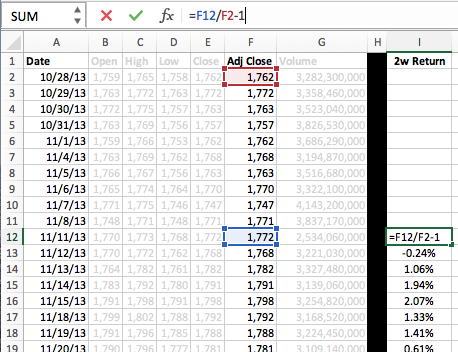
    2) Calculate the historical returns for your investment frequency (e.g. 2-week periods). Note: This frequency does not need to be the same as your investment frequency, but it makes things simpler. I’m also ignoring auto-correlation here — it doesn’t matter a lot.

    S&P500 2w Return Calculations
    S&P500 2w Return Calculations

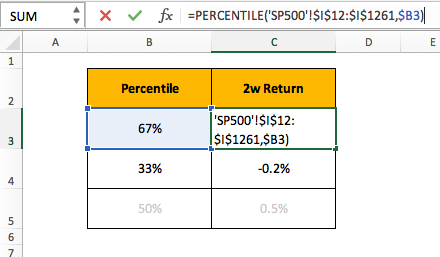
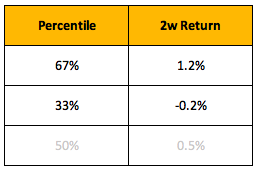
    3) Split the returns into the number of investment amounts you will be using (e.g. 3). We can do this using percentiles (e.g. 67th and 33rd) to split our 2-week returns into 3 buckets. Note: Effectively, we’re using percentiles to make the buckets equal in frequency (sort of), though this isn’t necessary. Roughly a third of the time we’ll see a return above 1.2%, a third of the time we’ll see a return between -0.2% and 1.2%, and a third of the time we will see a return below -0.2%.

    S&P500 2w Return Percentiles Calculation
    S&P500 2w Return Percentiles Calculation

    S&P500 2w Return Percentiles
    S&P500 2w Return Percentiles

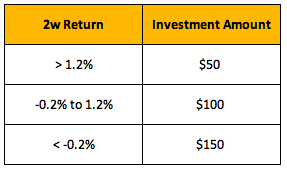
    4) Apply your investment amounts to the appropriate buckets. If the market is up a lot (bucket #1), we’ll only invest $50 and if the market is down a lot (bucket #3), we’ll invest a full $150. On average, however, we should be investing about $100 every 2 weeks.

    Variable Investment Amounts
    Variable Investment Amounts

    5) Remind yourself to quickly check returns and make your investment. For example, you could put a calendar reminder every 2 weeks to make a deposit into your Wealthfront account. That’s it. You’re done.

Tweaks to make to your VDCA for fun

VDCA is merely a system to help you invest in the markets consistently. You’ll invest a little more when the markets are down and invest a little less when the markets are up. The specifics of how you do this matter much less than actually sticking to your plan through thick and thin and making the system work for you. Below are some modifications that you can make, should you so choose to.

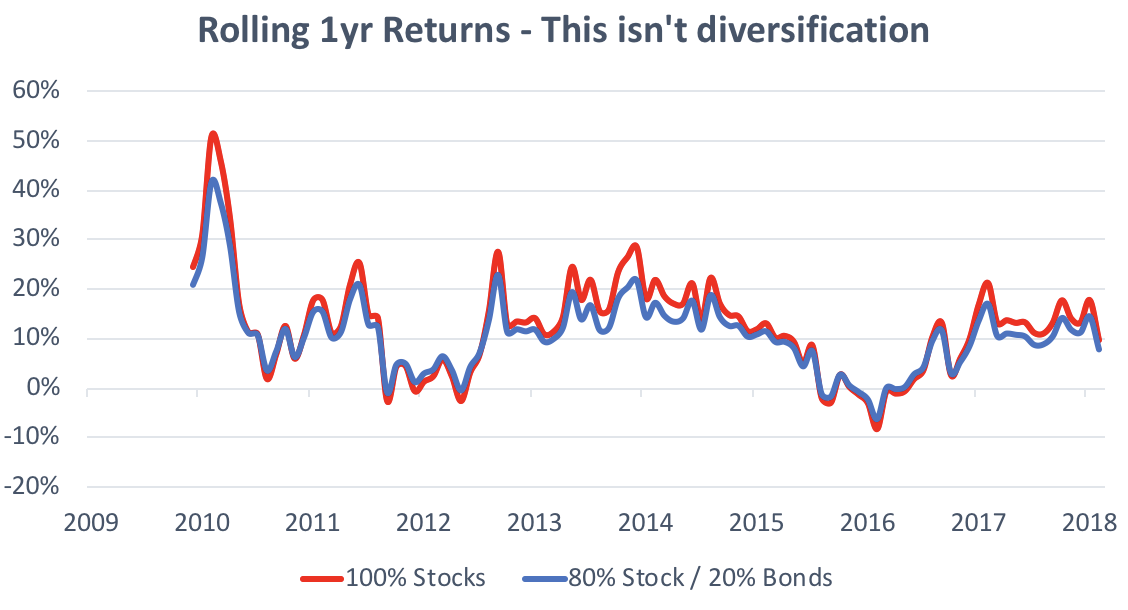
    1) If your portfolio materially differs from the S&P500, use the historical returns of your portfolio instead of those of the S&P500. And no, the 10% in bonds don’t help! Use these 2-week returns to set your percentile buckets instead.

    2) Tweak the variable and fixed splits. In our example, we are essentially making a fixed $50 investment every 2 weeks. On top of that, we make a variable investment of $0, $50, or $100. You may tweak this mix however you like. Isn’t it great that whether the market is up or down, you’re always investing (except a bit more when it’s down and a bit less when it’s up)?

    3) Add more buckets and granularity to your investment amounts, if you really feel like it. Instead of having 3 investment amounts, you can have 4 or even 5. Don’t get too complicated.

    4) The buckets don’t have to be equal sizes. You could invest $50 if the market has a top 20% return (80th percentile) and invest $150 if it has a bottom 20% return (20th percentile) and then invest $100 the other 60% of the time (20th to 80th percentile). If you do this, don’t forget to update your expected weekly investment calculation: in other words you will be investing $100 3 times more frequently than you will be investing $50 or $150.

The big deal about Risk Parity

On the heels of Wealthfront’s recent announcement of a risk parity offering there has been renewed interest in this decades old concept. In this first post of a series about Risk Parity for personal investing I’ll provide a primer on the strategy and why it is a big deal.

Risk parity says we should allocate our risk, not our capital

Risk parity is a concept that suggests investors allocate assets based on their risk, not merely the capital allocation. A simple, common asset allocation is $80 stocks and $20 bonds. Stocks are on average 2-4 times as risky as bonds. As a result, while the share of capital is 80% stocks and 20% bonds the share of risk is closer to 95% stocks and 5% bonds. Lamest diversification ever.

Risk parity portfolios are based on the premise that allocating capital doesn’t accurately reflect the risk of the assets in the portfolio. Risk parity, not capital parity.

Risk parity has higher allocation to lower risk assets like bonds

Bridgewater Associates pioneered the risk parity strategy through their famous All Weather Portfolio in the 1970’s. Since then, various implementations of the concept have been brought to market by other asset managers like AQR and Putnam. Essentially, these implementations all have larger capital allocations to bonds and lower capital allocations to equities than standard portfolios to more evenly divide the risk in the portfolio.

Risk parity trounces standard portfolios on return/risk ratios

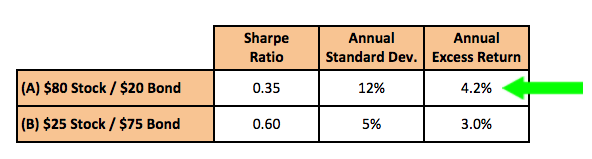
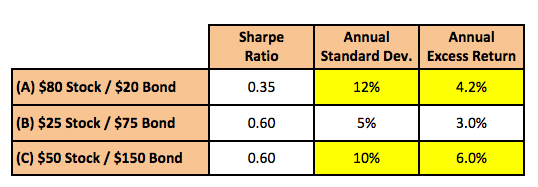
This is a big deal because a risk parity portfolio’s risk-based diversification offers higher returns versus the standard portfolio at equal levels of risk. A standard portfolio might achieve a 0.3 – 0.4 sharpe ratio (great primer), meaning that it provides 0.35 units of return for each unit of risk. For an average portfolio with an annualized standard deviation of 10%, this is a 3.5% annual excess return over cash. A well-managed risk parity portfolio on the other hand can deliver a sharpe ratio between 0.5 and 0.7 which translates to a 6.0% annual excess return.Note: To me the assertions here are supported by substantial evidence, but there are still smart people who will disagree with some of them. I’ll dig into some of of the assumptions in future posts.

Not everyone has access or ability to do risk parity

There are two reasons why this strategy isn’t far more widely used. First, not all investors have access to leverage and this strategy usually requires it. Second, professionally managed portfolios are expensive and/or have high minimums.

A standard $80 stock and $20 bond portfolio (Portfolio A) would return ~4.2% (12% volatility x 0.35 sharpe ratio). On the other hand, a $100 portfolio with equal stock and bond risk is $25 of stocks and $75 of bonds (Portfolio B) has a puny annual volatility of about 5%. This portfolio would return ~3% (5% volatility x 0.60 sharpe ratio). Since 4.2% is higher than 3% *and* 12% is acceptable risk for most under the age of 40, investors choose Portfolio A with a higher return.

Leverage (borrowing money to purchase securities) can double the excess return and risk of Portfolio B (200% leverage). We’ll achieve this by borrowing $100 and using it to buy another $25 of stock and $75 of bonds. This is new Portfolio C is $50 stocks and $150 bonds. Despite the use of leverage, it still has lower risk (10% vs 12%) and provides better returns (6.0% vs 4.2%).

Leverage lets us take superior, diversified portfolios and increase or decrease their risk to our desired level. We get more return for each unit of risk we take by doing this.

[yop_poll id=”1″]

cognitive biases investing

The Cognitive Biases That Plague Investors

It is very difficult to consistently invest profitably. Investment decisions are complex and as such are riddled with cognitive biases. Over a long enough time horizon even the most seasoned investors will succumb to many widely studied cognitive biases. They are human after all. This article discusses the cognitive biases that thwart investors. Some of these biases also prevent investors from sticking to tried and true investing advice.

The Investment Process

Investment decisions can be made in many different ways. Most of them involve answering different flavors of the same fundamental questions.

  • What opportunities are being sought?
  • What criteria are used to evaluate an opportunity?
  • What is the proper weighting of each criterion?
  • How are opportunities rigorously graded on each criterion?
  • What is a profitable purchase price?
  • Under what conditions should the asset be liquidated?
  • Navigating to the answers for each of these questions is fraught with risk of cognitive biases. The more these biases play into an investor’s decision the more likely the investor’s conclusions may be invalid. Below, I’ve listed some of the most common cognitive biases investors should be aware of. Additionally, I’ve included a brief example of an investment tactic or system that can mitigate the risk of this bias.

    Overconfidence Bias

    Overconfidence bias is a belief that one’s ability to beat the market is better than it truly is. More fundamentally, this effect means investors are more confident in their conclusions than they should be.

    Reducing the downside of being wrong is one way to mitigate this bias. Investor’s should always ask the question, “what if I am wrong?” and be comfortable with the answer to that question. Practically, setting (and more importantly, sticking to) position size limits can mitigate the effects of overconfidence. Setting reasonable limits ensures that investors do not “bet the farm” and lose everything if they are wrong. The risk of overconfidence is further mitigated by having a nuanced framework on how to size positions based on confidence level in the position. Forcing oneself to weigh the relative confidence of positions against one another encourages reflection on what one knows and does not know. Finally, incorporating consistent and measurable factors into the investment process will make it easier to spot overconfidence than if the entire process is qualitative. Occasionally revisiting past decisions and reviewing one’s success rate is often a humbling way to increase returns in the long run.

    Survivorship Bias

    Survivorship bias is most visible when investors are evaluating investment managers or making broad claims about the effectiveness of active management. The idea is that if hundreds of thousands of investors are betting on the markets, some will build an excellent track record not due to skill, but due to luck. This is a big reason investors often see the common disclaimer: “past performance is not necessarily indicative of future results”.

    Thoroughly understanding an investment manager’s investment process can mitigate the impact of survivorship bias. Investors should pay careful attention to the reasons a manager outperformed and not merely to the fact that they did outperform. An investor can develop a basis by which to differentiate the contribution of skill vs luck to the manager’s returns by deeply understanding the rationale behind the performance. Essentially, one must analytically assess the likelihood that a manager’s success was a byproduct of skill instead of luck. Separating the alpha and beta components of a manager’s returns can be a quantitative starting point for this discussion.

    Anchoring

    cognitive biases anchoring bias investing

    Anchoring is the tendency to place substantial (unjustified) weight on the first piece of information acquired in an investment decision. This often manifests itself as confirmation bias (don’t think I’ve forgotten) in favor of the original investment thesis. The current price of an investment is also an anchor that is frequently overvalued in decision-making

    Gathering informed opinions from others who have not yet been anchored is a method to mitigate the anchoring effect. Furthermore, managing an investment process to collect evidence before forming a hypothesis can also mitigate the effects of the anchor. A well-defined framework can specify which facts must be collected and what conclusions must be drawn without the need to start with questions about an existing hypothesis. Finally, a clear rubric assigning a weight (or ranges of weights) to various conclusions will limit anchor points from taking on more weight than they should.

    The bandwagon effect

    The bandwagon effect occurs when investment decisions are unduly influenced due to the conclusions of others. Imagine an investor who receives a stock tip from a friend. The investor may believe that his friend made an informed investment decision. In reality, that friend heard from his friend, who heard from her friend. This creates a situation where an investor may believe that 10 other disciplined investors did the work when in fact only one or two did. Many hedge fund analysts share their research with one another and as a result they have short (or long) positions in the same concentrated list of names (e.g Valeant).

    Following a disciplined investment process reduces the risk of herding. It is reasonable to weigh the opinions of others (based on your trust in them and your knowledge that the work they did deserves that trust). The risk, however, is overvaluing that opinion, especially when one has little understanding of why the recommendation was made in the first place.

    Loss Aversion

    The idea behind loss aversion is that humans have more aversion to loss than they have affinity for a gain of the same magnitude. The disposition effect is a specific case of loss aversion exhibited by investors. It is the tendency for investors to sell shares that have appreciated and hold onto shares that have an unrealized loss. No one likes taking a loss. The stock will bounce back eventually, right? right?

    Setting price limits and targets (though this is not without risks of it’s own) is a structured way to mitigate the impact of this effect. These targets and limits may be modified as new information is acquired. It is important not to let the disposition effect drive those changes, however, and ensure that the original investment process for calculating entry and exit points is followed. Finally, subordinating the weight placed on unrealized gains and losses (in fact an argument can be made that this should have almost no impact) can reduce the risk of falling prey to this bias.

    Confirmation bias

    cognitive biases confirmation bias investing

    Ah yes, the mother(fucker) of them all! Confirmation bias is the focus on finding and weighing more heavily, evidence that supports one’s initial hypothesis vs evidence that disproves it. Investors can browse their Facebook news feed for hundreds of daily examples of this phenomenon.

    As described above, adhering to the investment framework goes a long way in reducing confirmation bias. Adding detail around what criteria to use and how to measure it will reduce the likelihood that salient evidence is ignored. Additionally, playing devil’s advocate has helped substantially in my experience. Investors should independently try to make the strongest possible case for the investment as well as the strongest possible case against the investment. The investor can then think carefully about a trial where their life is at stake — they must make a case to a judge to go long or short. Which side is the investor most comfortable defending? This admittedly grim thought exercise compels decision-makers to carefully confront evidence on both sides.

    Other investing biases

    I’m tired of typing, so here is a laundry list of other biases to be cognizant of when investing:

    Availability bias
    Conservatism bias
    Zero-risk bias
    Pseudocertainty bias
    Outcome bias
    Nominal money illusion

    Unconscious Bias is Everywhere

    As should be evident, many of our investment decisions are steeped in unconscious bias. It is nearly impossible to remove all these biases from our decision-making. If we are cognizant of the pitfalls, however, we are far better armed to reduce the negative impact of the biases.

    One reason I am a huge proponent of roboadvisors is because they take everyday decisions out of our hands, frequently saving us from ourselves. A number of the systematic approaches outlined above to mitigate unconscious bias are programmed into Roboadvisors. The specifics of the algorithms have been rigorously tested.

    Investing is hard. Good luck out there.

    Find ways to compound everything you want to grow

    Your time gravitates naturally towards what you love to do. If what you love to do intersects with your work, then it is likely that often when you are not working you are doing things that further your excellence at your trade anyway. If these extra hours are the same as the hours you work, every year you do something gives you almost 2 years of experience. And if you work hard to be 30% more efficient, that multiplies the 2x. This consistent advantage compounds over time.

    Socially Responsible Investing Will Soon Be The Norm

    For the average investor, I am a strong proponent of investing in a diversified set of low-cost index funds which likely provides market-matching returns over the long run (or damn near close to it). Even though most investors under-perform this easy to achieve benchmark, many cannot help but try their hand at beating the markets because they do not want to settle for “table stakes.”

    Given the reality that our cognitive biases, overconfidence, and desire to have fun in the markets frequently supplant our rational judgment when it comes to investing, why not make a positive expected value (I assert) bet with positive externalities? To this end, I recommend socially responsible investing as a way to “play the markets,” do real good, and potentially earn superior returns.

    There is a growing body of evidence that suggests that socially responsible investing (SRI) has the potential to outperform conventional portfolios over time and the purpose of this post is to provide a quick overview of logic that supports this argument.

    Go to where the money will be.

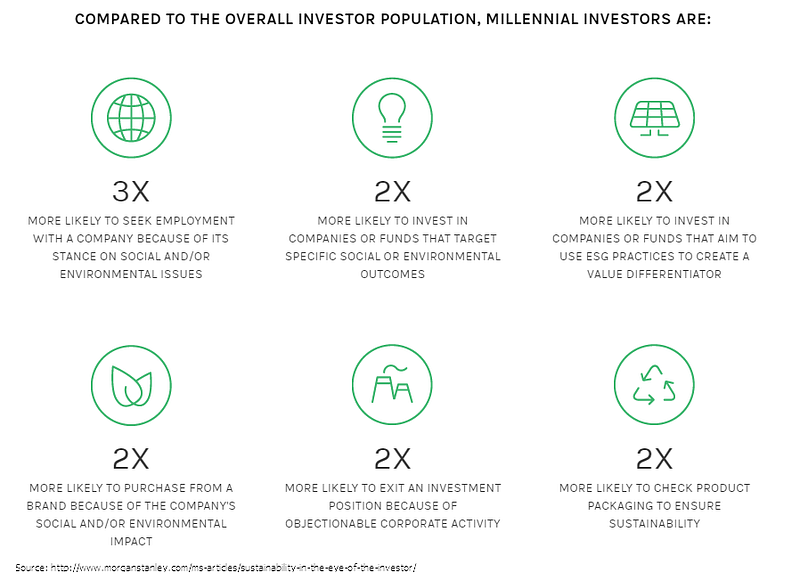
    Between today and my retirement, there is an estimated $30 Trillion of wealth that will transfer to millennials with almost $3 Trillion of that coming in the next 4 years. Pair this with the fact that millennials are 2x more likely to invest in companies that target specific social or environmental outcomes, and the fact that they are 2x more likely to exit an investment position because of objectionable corporate activity, and you are left with a large number of dollars that will systematically flow into socially responsible companies and out of objectionably behaved companies.

    This story by itself, if you believe it, is enough to generate a sensible investment thesis that is bullish on socially responsible organizations. The icing on the cake (gluten free and organic, of course) is that these large flows of capital have the potential to create powerful, self-reinforcing engines: cash flowing to these businesses lowers their cost of capital, increasing their efficiency (or growth potential if you don’t buy efficiency), and generating superior returns that in turn attract more investors.

    Too clean to fail.

    With the growing importance of these issues as expressed by millennials as well as scientific facts (global warming, water scarcity, etc.), it is not unreasonable to think government subsidies for sustainable practices, both in terms of dollars and regulatory benefits, will continue to grow considerably in coming years.

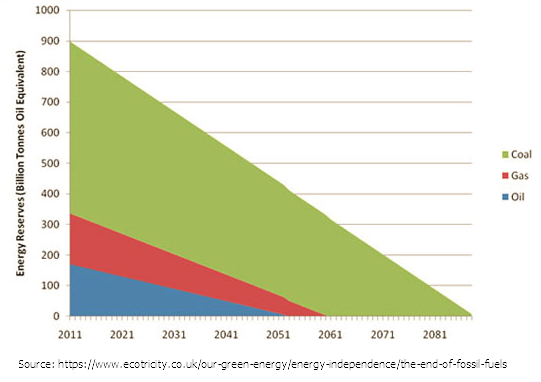
    Furthermore, there is strong evidence to suggest that the world will be afflicted with increased scarcity of resources (water, oil, fossil fuels) in our lifetimes. Business that begin to slowly shift to more sustainable practices will be well ahead of rising resource costs and business disruptions from supply shocks.

    Socially responsible investing outperforms empirically, too

    There is a study that studied studies that studied the relationship between environmental, social and governance (ESG) criteria and corporate financial performance (CFP). In total, some 2000 studies were evaluated. A staggering 90% of the studies suggests non-negative correlation between ESG and CFP. Put differently, 90% of the studies reviewed indicate that socially responsible companies perform equal to or better than those who do not follow that criteria.
    While there are macroeconomic and regulatory tailwinds for ESG-positive companies in the coming years, historical evidence has already provided significant evidence of financial out-performance. While the basket of low-cost index funds may be “the market” of today, there is reason to believe that it will under-perform the “new market” of tomorrow that is more accepting of ESG-criteria. Do you want to be left behind? And implicitly support the destruction of the earth? Of course not.

    Disclosure: I recently became an adviser to OpenInvest, a Y Combinator-backed startup whose mission is to make socially responsible investing the norm.

    Roboadvisors are good investment vehicles

    I write today in sadness and frustration.

    I hesitate to link to Blake Ross’ recent article on the tyranny of Wealthfront because it strikes a blow that sets my friends’ and generation’s investment goals back immeasurably. While I fear his colorful writing and celebrity status will likely confuse people into inaction, I hope this article will inspire you to action and shed light on some the inaccuracies and misrepresentations in Ross’ article.

    Before I begin my response, I implore readers: If you’ve been evaluating Wealthfront, Betterment, Vanguard Retirement Funds, or Schwab Intelligent portfolios over the last few months (or years) and can’t decide which to use — for the love of whatever you believe in, stop reading this post, roll a 1d4 and just pick one. They’re all better (by a large margin) than you leaving it in your checking account, spending it on something stupid, or giving it to an expensive active advisor. Go. Do it. Now. Which one did you choose? As the Rock would say, “it doesn’t matter [what you chose, as long as you chose].”

    Time for business.

    There is a lot of glossy rhetoric in Ross’ post and while I appreciate the passion and his renegade approach, I am upset by the misinformation. I’ll distill the rhetoric down to the key arguments and address those.

    Argument A: You’ll make more money with Vanguard Retirement Fund than a Roboadvisor – This is a strong claim that in Ross’ words, “There is simply no evidence, nor any theoretical reason, to believe”. It’s the hardest claim to prove but is also most important of the arguments. Simply put, the Wealthfront portfolio costs slightly more (quantified below) annually but probably makes up for this difference and then some due to tax loss harvesting (enough to close the gap alone), a likely superior asset allocation, a likely superior rebalancing strategy, and a faster rate of innovation.

    Argument B: Roboadvisor fees increase over time – This isn’t a particularly unique thing, and I’m not sure what the ultimate impact is of this argument, especially since Ross’ alternative suffers the same “flaw”. A number of business models include fee structures like this, especially when the benefit of the product increases over time as well. The fee does not rise on a percentage basis, but only on an absolute basis, and only if the Roboadvisor is making you money.

    Argument C: Tax-loss harvesting is too good to be true and the benefit is overstated – Ross agrees that there is an aftertax benefit to tax loss harvesting. His argument is that the magnitude of the impact is too small to matter. Unfortunately, even if we cut Wealthfront’s estimates by 10x and then refer to Ross’ citation about Tax Loss Harvesting, both sources claim an annualized benefit of at least 0.20%, which is already enough to push Wealthfront above Vanguard Retirement Funds. Finally, the author of Ross’ only substantive claim against the benefits of Tax Loss Harvesting actually supports Roboadvisors, and even Wealthfront specifically.

    Argument D: Roboadvisor fee structures are unprecedented – No they’re not.

    Note that while Ross decides to aim his critique primarily at Wealthfront, his arguments apply to Roboadvisors at large and so I’ll genericize my response where I can. When I use specific fee figures, I’ll use Wealthfront’s. Also note that Ross’ alternative is by no means bad, it’s just not better, and certainly not better to the degree that justifies the tone of his critique. I love Vanguard. They’re great.

    Onward…

    A. You’ll make more money with Vanguard Retirement Fund than a Roboadvisor

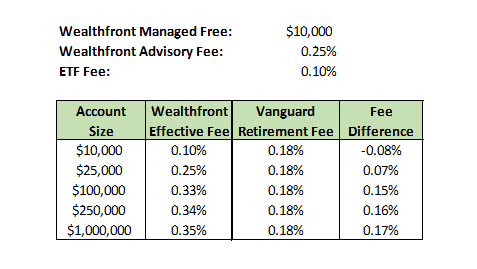
    1. The true fee difference is at most 0.17% in Vanguard’s favor, likely less – Ross overstates the cost difference between Wealthfront and Vanguard. Wealthfront’s portfolio costs at most 0.35% annually (closer to 0.33% for accounts with Direct Indexing). This fee is composed of a 0.25% fee paid to Wealthfront and a 0.10% fee paid to the administrators of the ETF that Wealthfront invests you in (mainly Vanguard, by the way). Ross’ “dirty secret” alternative (Vanguard Retirement Fund) charges 0.18%. Below is a comparison of total expenses for Wealthfront vs a Vanguard Retirement portfolio. Wealthfront manages $10,000 for free and adds an extra $5,000 managed for free for every client you refer to Wealthfront, reducing your blended costs. The table below assumes the minimum of $10,000 managed for free.

    Wealthfront Vanguard Fee Comparison

    Now, that means we need to see if Wealthfront can overcome 0.07% – 0.17% in annual fees. Let’s get to work.

    2. Tax Loss Harvesting by itself makes up for the difference and then some – Wealthfront claims Tax Loss Harvesting can add approximately 1.29% annually (2.03% if one includes tax-optimized direct indexing). While I agree with Ross that this figure is huge and potentially overstated, there’s (a) no evidence he provides to the contrary and (b) just ignoring it is hardly sensible. So even if we decimate Wealthfront’s claim, we get to a 0.20% benefit from TLH with TODI. So this means that 1/10th of Wealthfront’s claimed Tax Loss harvesting makes up the fee difference by itself, and then some. I contend that Ross’ arguments show a misunderstanding of what TLH is and the mechanics of how it works. I’ll dive into this in depth in the TLH section.

    3. Ross likely misrepresents Buffett’s viewpoint – Furthermore, he mis-characterizes a Buffett quote as evidence to assail robo-advisors: “… Put 10% of the cash in short-term government bonds and 90% in a very low-cost S&P 500 index fund. (I suggest Vanguard’s.) I believe the trust’s long-term results from this policy will be superior to those attained by most investors — whether pension funds, institutions or individuals — who employ high-fee managers.” First, if you asked Mr. Buffett whether 0.37% is a high-fee manager, I’d wager he wouldn’t think it was too bad given the management fees being in the 1-2% for most of his lifetime and given Ross’ own argument that WF has significantly lower fees than other advisors and given that Ross’ alternative has fees that are less than 0.20% lower. Second, I’d also place a wager that Buffett is referring to active managers (most Roboadvisors are passive asset allocators). Third, Wealthfront disputes Ross’ claim directly in an article that compares the Wealthfront portfolio to Buffett’s recommendation. Finally, Buffet’s allocation is obviously an oversimplification that can and should be improved upon. Or is it? Let’s see what the experts have to say about the importance of a diversified asset allocation.

    4. Asset Allocation matters a lot – In a seminal 1985 paper it is argued that asset allocations explained almost 94% of a portfolio’s return versus other factors contributing 6%. The administrators of Mr Ross’ alternative also believes this too as evidenced by a Vanguard-published paper stating that almost 77% of portfolio performance comes from asset allocation decisions (they removed some factors from being classified as asset allocation that the Brinson paper includes). If academics don’t convince you, fine.

    5. Good investors also think asset allocation matters a lot – Some not-so-bad investors say stuff too. “Asset allocation is critically important; but cost is critically important, too—All other factors pale into insignificance.” -John Bogle, founder of Vanguard. “The most important decision you will probably ever make concerns the balancing of asset categories (stocks, bonds, real estate, money market securities, etc.) at different stages of your life.” -Professor Burton Malkiel, author of A Random Walk Down Wall Street, way before he became Wealthfront’s CIO. “Choose your asset allocation model carefully. Asset allocation is the biggest factor in determining your overall return.” -Charles Schwab.

    6. Figuring out asset allocation difference is hard, we have to evaluate it systemically – Now, the question is whether Wealthfront’s asset allocation is better or worse than the Vanguard retirement fund’s. This is a very, very tricky question to answer because there’s really no concrete way to know aside from just seeing how they perform. The issue with that approach is you don’t know systematically which (if either), will outperform. You only know what actually happened, which is significantly influenced by chance. What we can do, however, is understand the process each manager employs to see if there are systematic biases to outperform the other or not.

    7. Vanguard portfolios are more constrained than Wealthfront’s – Vanguard’s Retirement portfolios use their own funds. Wealthfront has no such requirement. That means that in cases where an asset allocation would be better served by having a non-Vanguard fund that provides a certain set of exposures, Vanguard must find a close proxy, create a new fund, or risk underperformance. Wealthfront has the opportunity to find the best alternative (which happen to be Vanguard MOST of the time). It’s tough to quantify, but the argument is simply that a constrained portfolio is likely worse than a less constrained one.

    7. Wealthfront’s rebalance strategy is likely more sophisticated than Vanguard’s -Furthermore, Wealthfront’s rebalance strategy is optimized to minimize drift while keeping costs at bay, a strategy advocated by Vanguard. While Wealthfront has developed software to assess the trade-off between these two sides in real time (it operates continuously), Vanguard does it daily (because they receive fund inflows and outflows daily) incurring small costs on the fund each time and requiring discrete decision-making which is not real-time. Additionally, there is evidence to believe that Vanguard uses time-based and threshold based triggers, which they admit in their own white paper have issues. While the impact here is likely small, it is yet another systematic benefit to an automated strategy like Wealthfront’s.

    8. Wealthfront’s rate of innovation is fast – Finally, Wealthfront has been at the Vanguard (see what I did there?) of change in the industry for a long time. I will say that Vanguard’s innovations are great, but Wealthfront has been the Roboadvisor that has consistently pushed the envelope, developed new strategies, reduced cost via cheaper ETF’s, and made more features available to smaller investors faster. Others follow suit of the star-studded investment team from Wealthfront. Purely on a trust basis, I would trust the investment analysis (I’ve verified enough myself) of Wealthfront. Even beyond that, there’s a tangible benefit being the leader of innovation because your investors realize the benefits of the features while investors in other funds must wait for the innovations. Wealthfront discusses this specific argument here.

    9. Ross’ critique minimizes the impact of human psychology (and lack of logic) on financial decisions – Ross says, “If you open a retirement account, and you invest some of your paycheck each month into a Vanguard Target Retirement Fund, and you just…leave it… until retirement… you don’t do anything when the folks on CNBC announce that the sky is falling; you don’t do anything when Cousin Eddy calls from a secure underground bunker in the badlands and says that the fed is printing money and it’s time to liquidate and ammo up; you don’t think it’s a sign that your parrot said “fuhgeddaboutit” but you thought she said “get a nugget” and surely that must mean a gold nugget? and you looked online and noticed that the price of shiny yellow metal was crashing and wait your parrot is also yellow and I’ll be damned if that isn’t a sign to buy… no, if you just leave it there to compound over decades… then you will probably make more money than … if you used Wealthfront.” That’d be nice, but it rarely happens. The story of Peter Lynch and the Magellan Fund is a cautionary tale. He ran the Fidelity Magellan fund for 13 years and achieved a ~30% annualized return. The average investor in the fund, however, actually lost money. This happened because investors would fear on the dips and sell and chase returns after a big run up. They essentially broke the cardinal rule of investing by selling low and buying high, over and over again. An automated advisor protects you from yourself marginally more than a portfolio you need to manage more (or even a Vanguard Retirement Fund which is psychologically easier to view as a single investment rather than money with an advisor).

    10. Vanguard Retirement Funds are either less tax efficient (in taxable accounts) or they are less optimized (in non-taxable accounts) than the Wealthfront portfolio — Wealthfront offers different asset allocations for taxable and non-taxable accounts in order to optimize tax treatment. The Vanguard Retirement Fund is a single entity that holds a single asset allocation is not individually optimized for one type of account or the other. The impact of this is non-negligible.

    B. Roboadvisor fees increase over time

    1. Yes, they do – But only if they make you money. There doesn’t seem to be a differential implication presented.

    2. It’s pretty common – In fact, many businesses (even those not on Wall Street) have a business model that charges increased fees based on usage. Many SaaS companies charge by seat. Many data businesses charge by volume of data processed/stored. There seems to be no distinction drawn between Roboadvisors and these other businesses.

    3. Vanguard’s got the same “issue” – In fact, the suggested alternative (Vanguard Retirement Fund) charges exactly the same way.

    4. What do you believe? There’s a philosophical / value-based question on whether you think the fee should be proportional. If the value being provided is proportional (it is for many SaaS companies, and it is for Wealthfront too), then I personally find it fair to charge a fee in this way. You’ll have to figure out for yourself what you believe on this one.

    5. The structure aligns incentives – Furthermore, Wealthfront is better than a number of the alternative subscription-based models in that the fee only increases if your outcomes improve (portfolio value increases). SaaS models that charge by seat cost you more as your # of seats grow, but don’t cost you less if the seats do dumb things with the product or if the seats use the product less. It’s incentive alignment, not predatory pricing.

    6. Ross misrepresents rarity of the model – He argues, “It’s not just that Wealthfront charges users for its software, which is rare.” This one made me angry so I had to take a break to watch Netflix and listen to Spotify before coming back to blog on my personal domain. He also argues, “It’s also that, on average, Wealthfront increases its subscription fee every day.” Yes, I agree. But the question is whether you are OK watching your investment balance grow by $100 while watching the fee grow by $0.25. If you’re not, then I ask about the alternative. His alternative is structured similarly.

    7. Roboadvisors are not merely providing advice – Finally he says, “Stop charging proportional fees for advice,” to which I say Roboadvisors provide more than merely advice. They provide services like trading for you, keeping up with changes in ETF fees and landscape, rebalancing intelligently instead of periodically, tax loss harvesting and performance tracking. As mentioned earlier, a number of the services above have benefits that in fact do scale with the size of the account. The implication of the statement above is that one should pay fixed fees but gain bigger benefit over time from those fees.

    8. Wealthfront has never been profitable – In response to the “Wealthfront helps itself to such margins” argument, it is important to note that the company is not profitable and won’t be profitable any time in the next few years. You can write that in pen. On the 2bn they manage, they’re revenue is less than $5mm. They’ve lost money for every year they have been in existence. Vanguard runs at cost, according to Ross’. I’d prefer to let the VC’s subsidize me.

    C. Tax-loss harvesting is too good to be true and benefit is overstated

    1. We need to save in taxable accounts too – Ross argues that “If your nest egg exists entirely in a retirement account, as it does for many Americans, then tax loss harvesting won’t help you at all.” While this is true, I’d argue that it is a big deal that Wealthfront is providing incentive (TLH) to invest outside retirement accounts, given the dire state of savings rates in our generation.

    2. ETFs have capital gains too – With Ross’ argument that “If you practice the kind of investing that Wealthfront itself evangelizes — buy-and-hold, passive, rational, long-term indexing that is rebalanced with new money or in retirement accounts — then you should not be realizing capital gains regularly anyway.” he fails to mention that his alternative also recognizes capital gains regularly. Most ETF’s distribute capital gains at the end of the year and do not harvest losses, so you’re basically paying capital gains taxes in either scenario. Furthermore this cuts against Ross’ argument that tax loss harvesting gains are capped while Wealthfront’s fees are uncapped.

    3. Even rudimentary TLH is enough for Wealthfront to come out on top – Furthermore, Ross’ argument against Tax Loss Harvesting as made by the Kitces article above actually says that 0.20% improvements are based upon lumpy and dumb harvesting (once/year, at the end of the year) versus a much more sophisticated, real-time algorithm employed by Wealthfront.

    4. Ross’ own citation makes a pretty strong case for Roboadvisors – The same author who Ross cites also writes a pretty good article about How Declining Transaction Costs And Robo-Indexing Could Disintermediate Index Mutual Funds And ETFs.

    D. Roboadvisor fee structures are unprecedented.

    No they’re not.

    Conclusion

    Invest your money in low cost ETF’s. If you have a taxable account and don’t want to spend time on it, I recommend Wealthfront. If you don’t have a taxable account and have time, you can mimic Wealthfront’s allocation and rebalance yourself. You can pick Betterment. You can pick Wise Banyan. You can pick Schwab Intelligent Portfolios. You can pick Vanguard Retirement funds. Do something with your money. But please don’t be paralyzed into inaction by rhetoric. The Roboadvisors will also help you avoid destructive cognitive biases.

    Wealthfront vs Schwab Intelligent Portfolios: A Third Take

    Recently Adam Nash, the CEO of Wealthfront published a piece on medium lamenting how Charles Schwab lost its way, citing the launch of the Schwab Intelligent Portfolios (SIPs) as evidence. Soon thereafter, Charles Schwab responded, calling part of Nash’s example “criminal” (a trope used by Nash himself to describe Schwab’s approach). In this article, I’ll breakdown the arguments and illustrate how even in the best case scenario for Charles Schwab, their SIPs are still a bit worse than Wealthfront’s portfolio.

    The Wealthfront Argument:

    1. The SIPs hold sub-optimally large cash balances.
    2. Schwab pays a sub-market return on those cash balances.
    3. SIPs are self-serving because they use a sub-optimal asset allocation to funnel assets into Schwab’s preferred funds.
    4. SIPs preferred “Smart Beta” ETFs have high fees that are not justified by the value smart beta adds.

    The Charles Schwab Argument:

    1. SIPs cash balances are totally reasonable sizes. Good portfolios have cash balances.
    2. Smart beta portfolios are acceptable and outperform traditional market-cap weighted indices.

    The Cash Question

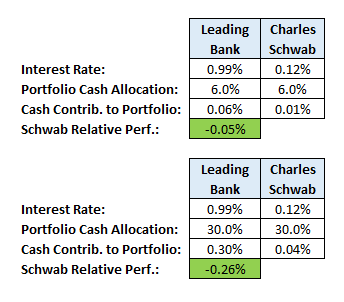
    Nash says SIPs cash balances are too high. Schwab says they’re reasonable. Who do you believe? It turns out the more important fact is Nash’s 2nd argument that Schwab pays a sub-market return on cash balances, a claim unrefuted by Schwab. According to Nash’s figures, Schwab pays 0.87% less on it’s cash balances than a leading competitor bank (0.99% vs 0.12%). SIP’s with a 6% cash balance and a 30% cash balance create a 0.05% and 0.26% drag on the entire portfolio (relative to the leading competitor bank) because of Schwab’s stingy interest paid on cash balances. This is illustrated in the table below.

    Schwab Cash Drag

    If Schwab was truly trying to be consumer friendly, they could have chosen 1 of 2 approaches that would remain consistent with their viewpoint that moderate cash balances are prudent investing strategy (i.e. if you disagree with Nash’s view that low cash balances are better):

    1. Schwab could use the Wealthfront approach by keeping minimum cash on hand and encourage clients to leave moderate cash balances (that are currently being held in SIPs in the sweep allocation) in their external accounts with higher interest rates. This would meet Schwab’s “cash balance is prudent” requirement as well as provide optimal cash return to the client.
    1. They could just offer a competitive interest rate on cash balances.
  • But they chose to do neither which leads me to conclude that Nash’s explanation probably rings true: “follow the money.”

    Asset Allocation: A story of mis-aligned incentives

    Wealthfront’s fee is charged for the management of a portfolio of ETF’s. The management includes smart asset allocation, optimized rebalancing, and automated tax loss harvesting. To earn it’s management fee, it is in Wealthfront’s best interest to select a low-cost and appropriately diversified set of ETF’s — so the portfolio performs well, clients stay happy and the asset base grows (benefitting both Wealthfront and the client). This is a dream incentive alignment for clients.

    Schwab’s Intelligent portfolios on the other hand, are mired in some incentive alignment issues. While SIPs fee structure also incents asset base growth, there is also a strong incentive to steer clients towards Schwab products, and expensive Schwab products in particular. In fact, SIPs allocate a large portion of assets (I have seen 60% quoted in some places) to Schwab’s own smart beta products. These smart beta products average an expense ratio of ~0.35%, roughly 3 times the cost of Vanguard ETF’s used by Wealthfront.

    The tough question is whether Wealthfront’s asset allocation is better or worse than Schwab’s asset allocation. Schwab makes the claim that their smart beta portfolios do indeed outperform traditional asset mixes, though I have yet to see definitive evidence of this or even a quote on the magnitude of the difference in performance. Some in-depth analysis (which I’d love to see Wealthfront or Schwab actually do) will be required to answer this question. What I can say though is that it seems a little too convenient to me that SIPs utilize Schwab’s high-priced products in such large quantities.

    Conclusion

    In the best case scenario you believe that (1) Schwab is not nudging allocations to their benefit and (2) a reasonable cash balance should be held in a portfolio. Unfortunately, even in this base case scenario, SIPs still slightly underperform a Wealthfront portfolio.

    The Wealthfront portfolio costs 0.25% plus the underlying cost of the ETFs (~0.12%) for a total annual expense ratio of ~0.37%. We’ll assume that we invest 90% of our cash in this portfolio and 10% in cash at a leading competitor bank. This means the fee we pay to Wealthfront is 0.33% (0.37% fee * 90% of portfolio) and we earn a 0.10% contribution to the portfolio from cash (10% balance at 0.99% interest).

    While SIPs have no management fee, they do allocate to underlying funds costing 0.20% – 0.40%. If we take an average SIP, we’ll pay 0.27% in fees (0.30% underlying fund costs * 90% invested) and we will earn a 0.01% contribution to the portfolio from cash (10% balance at 0.12% interest).

    What this nets out to is that the Wealthfront portfolio is 0.06% more expensive in fees, and earns you 0.09% more in cash return, netting out to a 0.03% advantage for Wealthfront in the most bullish scenario for the Schwab Intelligent Portfolios. Plus, don’t forget Wealthfront’s Tax Loss Harvesting on all taxable portfolios (Schwab has a significant minimum balance requirement for TLH).

    Now, at the end of the day, if you’re not investing your money because you can’t decide between Wealthfront, Betterment, Schwab Intelligent Portfolios, or Wise Banyan — you should just roll a damn 1d4 (if you don’t have one, I’m happy to roll mine for you) and pick one, because they’re all far better than your cash sitting in a checking account.

    My Former Big Boss Explains the Economic Machine

    This is an excellent video done by Ray Dalio, CEO and Founder of Bridgewater Associates. It does a great job explaining how the economic machine works in a very simple, digestible way. Enjoy.

    Scroll to Top