Decisionmaking

Don’t Outsource Your Thinking

It feels good to be writing in public again.

My time spent in the world of capital allocation, whether in venture or at a hedge fund, taught me that writing is often more about institutional messaging than personal inquiry. The layers of compliance and strategic consideration are necessary, of course, but I found they can temper the spirit of open exploration. The liberty to now write for myself, to simply think in public, is a freedom I’m excited to reclaim.

So, I’m back. And I thought I’d start by sharing a bit about the evolution of my process: how I think, how I write, and how I’m learning to partner with Artificial Intelligence.

Why I Write: The Search for Clarity

Since 2011, I’ve kept a running notebook (physical and digital) that has become a sprawling archive of my brain. It’s filled with notes, reflections, and half-baked essays on everything from statistical models and product strategy to being a better father and husband.

This started as a simple habit, but over time, I’ve found it’s become essential for my own mental well-being. Writing is the most reliable tool I have for untangling complexity. When I’m stuck on a problem, when a decision feels fuzzy, or when I just feel a general sense of unease about something, I write. For me, wrestling with an unformed idea is like navigating a thick fog. There’s a disquieting sense of knowing something is there without being able to see it, and the act of writing is what finally parts the mist, revealing the path ahead. It reveals the flaws in my own logic and the gaps in my thinking. I find that I can’t bluff myself on a blank page.

For years, this practice was mostly private, a tool for my own clarity. Now, I’m trying to add that final step of publishing, and I’m finding it adds a new, welcome layer of rigor to my process.

My New Sparring Partner

My writing workflow has changed a lot in the last few years. While I use AI every day, I’ve found my process looks a bit different from how some people seem to use these tools. For me, asking it to “write a blog post about X” would feel like outsourcing the part of the work I value most.

Instead, I’ve settled into treating it like an endlessly patient and brutally honest sparring partner. It’s become the bridge that helps me get from the initial chaos of an idea to a coherent, pressure-tested structure. My job is still to provide clear, nuanced direction; its job is to organize, challenge, and reflect my thinking back to me at the speed of light.

To share what this looks like in practice, let me walk you through a recent example. Awhile back, I was building the business case for a major investment in a new data analytics platform. My head was a mess of disconnected thoughts: total cost of ownership, complex integration challenges, potential ROI, vendor comparisons, competing stakeholder needs, optimistic vs. realistic implementation timelines, and the significant risks of doing nothing while deeply understanding the firm’s aversion to additional costs..

Step 1: The Brain Dump and Thematic Sort I dumped all of it into a prompt, hundreds of words of pure stream-of-consciousness. My request was simple: “I’m building a business case for a new analytics platform. Here are my raw thoughts. Please organize them into a logical structure for a strategy document.”

Instantly, the AI took my jumbled list and returned a clean structure with five sections: The Problem, The Proposed Solution, Financial Impact (ROI & TCO), Implementation Plan & Risks, and Expected Outcomes. It was a solid, standard starting point that immediately gave a skeleton to my chaotic thoughts.

Step 2: The Adversarial Pressure Test This, for me, is where the process gets really interesting. I then gave the AI (often a different LLM) a new persona: “Now, act as a skeptical CFO who is unconvinced of the ROI and deeply concerned about the budget and headcount required. Rip this business case apart. Tell me where the financial assumptions are weak, where the plan is naive, and what crucial questions I’m failing to answer.”

The response was informative and humbling. It pointed out that my ROI calculations were based on overly optimistic adoption rates and that I hadn’t adequately budgeted for the “hidden costs” of training. It flagged that my timeline didn’t account for likely delays from the engineering team. It was the kind of direct, ego-free feedback that is incredibly difficult to get from a human colleague on a busy afternoon, and it was exactly what I needed to see the weaknesses in my own case. It forced me to confront the base rate of failures, even though my contextual perspective suggested higher probabilities of success. It wasn’t clear who was right, but it sharped my understanding of the considerations.

Step 3: The Iterative Loop I spent the next hour in a back-and-forth dialogue with the model, refining my points while it challenged the revisions. By the end of this process, I didn’t have a finished document, but I had something much more valuable: a robust, coherent, and battle-tested argument that I felt much more confident in. Every once in awhile, if the step-by-step incremental approach isn’t yielding what I want, I’d paste a chunk of the conversation into a fresh chat window, with my feedback on how I want to “holistically re-imagine” the write-up with specific feedback, and I’ll often get a complete re-orientation that’s a marked improvement.

Only then did I open a blank page and begin to write the prose myself, with a lot less help from an LLM.

Protecting the Muscle

This partnership is working for me so far, but I’m still figuring out where to draw the line. For me, relying on AI to do the final writing would feel like taking an escalator instead of the stairs. It’s faster, but I worry that if I did it all the time, the mental muscles I need for the climb would begin to fade.

The act of choosing the right word, structuring a sentence, and weaving a narrative is where I find the deepest thinking about persuasion and effectiveness happens. That work relies on a set of skills I’m trying to cultivate: taste, intuition, and strategic empathy.

More importantly, it forces me to draw on context that AI simply does not have. So much of what informs my perspective comes from the data that isn’t in a dataset like the hesitation in a project lead’s voice, the unspoken dynamic between departments in a strategy meeting, or a pattern of resistance I might recognize from a dozen similar initiatives. I feel my writing needs to be infused with that full, messy, human picture to be valuable.

For me, figuring out what matters and how to say it remains the core work. My working theory is that in a world increasingly saturated with machine-generated content, this human act of judgment will become more important, not less.

What’s Next

Going forward, I’m excited to use this space to explore the questions I’m wrestling with. I’ll be writing about the evolution of data science and product development, the messy reality of decision-making in business, and the economic frameworks I’m using to try to make sense of a rapidly changing world.

This is just the process I’ve landed on for now, and I’m sure it will continue to evolve. I’m genuinely curious to hear how others are navigating this. If you have a workflow of your own, or see things differently, I’d love to hear about it.

Thanks for reading.

cognitive biases investing

The Cognitive Biases That Plague Investors

It is very difficult to consistently invest profitably. Investment decisions are complex and as such are riddled with cognitive biases. Over a long enough time horizon even the most seasoned investors will succumb to many widely studied cognitive biases. They are human after all. This article discusses the cognitive biases that thwart investors. Some of these biases also prevent investors from sticking to tried and true investing advice.

The Investment Process

Investment decisions can be made in many different ways. Most of them involve answering different flavors of the same fundamental questions.

  • What opportunities are being sought?
  • What criteria are used to evaluate an opportunity?
  • What is the proper weighting of each criterion?
  • How are opportunities rigorously graded on each criterion?
  • What is a profitable purchase price?
  • Under what conditions should the asset be liquidated?
  • Navigating to the answers for each of these questions is fraught with risk of cognitive biases. The more these biases play into an investor’s decision the more likely the investor’s conclusions may be invalid. Below, I’ve listed some of the most common cognitive biases investors should be aware of. Additionally, I’ve included a brief example of an investment tactic or system that can mitigate the risk of this bias.

    Overconfidence Bias

    Overconfidence bias is a belief that one’s ability to beat the market is better than it truly is. More fundamentally, this effect means investors are more confident in their conclusions than they should be.

    Reducing the downside of being wrong is one way to mitigate this bias. Investor’s should always ask the question, “what if I am wrong?” and be comfortable with the answer to that question. Practically, setting (and more importantly, sticking to) position size limits can mitigate the effects of overconfidence. Setting reasonable limits ensures that investors do not “bet the farm” and lose everything if they are wrong. The risk of overconfidence is further mitigated by having a nuanced framework on how to size positions based on confidence level in the position. Forcing oneself to weigh the relative confidence of positions against one another encourages reflection on what one knows and does not know. Finally, incorporating consistent and measurable factors into the investment process will make it easier to spot overconfidence than if the entire process is qualitative. Occasionally revisiting past decisions and reviewing one’s success rate is often a humbling way to increase returns in the long run.

    Survivorship Bias

    Survivorship bias is most visible when investors are evaluating investment managers or making broad claims about the effectiveness of active management. The idea is that if hundreds of thousands of investors are betting on the markets, some will build an excellent track record not due to skill, but due to luck. This is a big reason investors often see the common disclaimer: “past performance is not necessarily indicative of future results”.

    Thoroughly understanding an investment manager’s investment process can mitigate the impact of survivorship bias. Investors should pay careful attention to the reasons a manager outperformed and not merely to the fact that they did outperform. An investor can develop a basis by which to differentiate the contribution of skill vs luck to the manager’s returns by deeply understanding the rationale behind the performance. Essentially, one must analytically assess the likelihood that a manager’s success was a byproduct of skill instead of luck. Separating the alpha and beta components of a manager’s returns can be a quantitative starting point for this discussion.

    Anchoring

    cognitive biases anchoring bias investing

    Anchoring is the tendency to place substantial (unjustified) weight on the first piece of information acquired in an investment decision. This often manifests itself as confirmation bias (don’t think I’ve forgotten) in favor of the original investment thesis. The current price of an investment is also an anchor that is frequently overvalued in decision-making

    Gathering informed opinions from others who have not yet been anchored is a method to mitigate the anchoring effect. Furthermore, managing an investment process to collect evidence before forming a hypothesis can also mitigate the effects of the anchor. A well-defined framework can specify which facts must be collected and what conclusions must be drawn without the need to start with questions about an existing hypothesis. Finally, a clear rubric assigning a weight (or ranges of weights) to various conclusions will limit anchor points from taking on more weight than they should.

    The bandwagon effect

    The bandwagon effect occurs when investment decisions are unduly influenced due to the conclusions of others. Imagine an investor who receives a stock tip from a friend. The investor may believe that his friend made an informed investment decision. In reality, that friend heard from his friend, who heard from her friend. This creates a situation where an investor may believe that 10 other disciplined investors did the work when in fact only one or two did. Many hedge fund analysts share their research with one another and as a result they have short (or long) positions in the same concentrated list of names (e.g Valeant).

    Following a disciplined investment process reduces the risk of herding. It is reasonable to weigh the opinions of others (based on your trust in them and your knowledge that the work they did deserves that trust). The risk, however, is overvaluing that opinion, especially when one has little understanding of why the recommendation was made in the first place.

    Loss Aversion

    The idea behind loss aversion is that humans have more aversion to loss than they have affinity for a gain of the same magnitude. The disposition effect is a specific case of loss aversion exhibited by investors. It is the tendency for investors to sell shares that have appreciated and hold onto shares that have an unrealized loss. No one likes taking a loss. The stock will bounce back eventually, right? right?

    Setting price limits and targets (though this is not without risks of it’s own) is a structured way to mitigate the impact of this effect. These targets and limits may be modified as new information is acquired. It is important not to let the disposition effect drive those changes, however, and ensure that the original investment process for calculating entry and exit points is followed. Finally, subordinating the weight placed on unrealized gains and losses (in fact an argument can be made that this should have almost no impact) can reduce the risk of falling prey to this bias.

    Confirmation bias

    cognitive biases confirmation bias investing

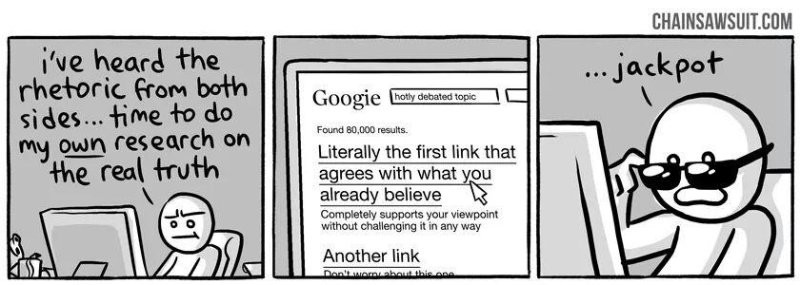
    Ah yes, the mother(fucker) of them all! Confirmation bias is the focus on finding and weighing more heavily, evidence that supports one’s initial hypothesis vs evidence that disproves it. Investors can browse their Facebook news feed for hundreds of daily examples of this phenomenon.

    As described above, adhering to the investment framework goes a long way in reducing confirmation bias. Adding detail around what criteria to use and how to measure it will reduce the likelihood that salient evidence is ignored. Additionally, playing devil’s advocate has helped substantially in my experience. Investors should independently try to make the strongest possible case for the investment as well as the strongest possible case against the investment. The investor can then think carefully about a trial where their life is at stake — they must make a case to a judge to go long or short. Which side is the investor most comfortable defending? This admittedly grim thought exercise compels decision-makers to carefully confront evidence on both sides.

    Other investing biases

    I’m tired of typing, so here is a laundry list of other biases to be cognizant of when investing:

    Availability bias
    Conservatism bias
    Zero-risk bias
    Pseudocertainty bias
    Outcome bias
    Nominal money illusion

    Unconscious Bias is Everywhere

    As should be evident, many of our investment decisions are steeped in unconscious bias. It is nearly impossible to remove all these biases from our decision-making. If we are cognizant of the pitfalls, however, we are far better armed to reduce the negative impact of the biases.

    One reason I am a huge proponent of roboadvisors is because they take everyday decisions out of our hands, frequently saving us from ourselves. A number of the systematic approaches outlined above to mitigate unconscious bias are programmed into Roboadvisors. The specifics of the algorithms have been rigorously tested.

    Investing is hard. Good luck out there.

    Scroll to Top